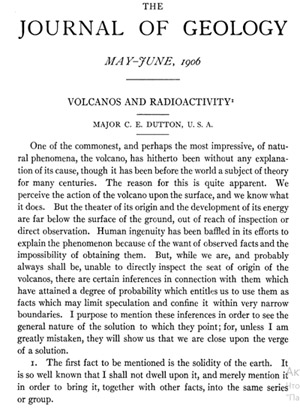
Volcanos
and Radioactivity.
MAJOR C. E.
DUTTON,
U. S. A.
1906
|
|
|
|
Rapid
and precise measurements of radon in water using a pulsed
ionization chamber.
Junhyeong Seo , Guebuem Kim *
School of Earth and Environmental Sciences/Research Institute of
Oceanography, Seoul National University, Seoul, South Korea
|
Abstract.
Radon-in-air
monitor (RAD7, Durridge Co.) has been widely used to measure 222Rn in
water samples. RAD7
measures 222Rn via 218Po+ (t1/2 = 3.1 min), which is electrically
attracted to a silicon alpha detector. In this study,
a new method was developed for measuring 222Rn in water samples by
modifying a commercially available
pulsed ionization chamber (PIC, FT-Lab Co.). The PIC detects and
amplifies the electric pulses generated by
microspace charges produced by 222Rn decay. Two passive PICs (volume: 2
× 400 mL) were combined and modified to form an active system (named
Rn-SNU) that continuously circulates air (~ 1 L min−1
). Rn-SNU is approximately seven to nine times more efficient than RAD7
and does not necessitate a delay of ~ 15 min to reach
radioactive equilibrium between 222Rn and 218Po+
. However, RAD7 is more accurate in discriminating 222Rn
daughters, 218Po+ and 214Po+
. In this study, 222Rn was successfully measured in coastal seawater
samples using
Rn-SNU connected to a grab bottle. Our results suggest that 222Rn
measurements in water samples can be conducted more efficiently and
rapidly with an Rn-SNU than with other widely used instruments and
methods.
|
|
|
In-situ
radon-in-water
detection for high resolution
submarine groundwater
discharge assessment.
Shibin Zhao1,2,3, Meng Li 4
, William C. Burnett 5
, Kai Cheng 4
,
Chunqian Li 4,6, Jinjia Guo4
, Songling Yu 4
, Wen Liu1,2,3
,
Tong Yang 4
, Natasha T. Dimova7
, Guangquan Chen 8
,
Zhigang Yu1,2 and Bochao Xu1,2*
1Frontiers Science Center for Deep Ocean Multispheres and Earth System,
and Key Laboratory of
Marine Chemistry Theory and Technology, Ministry of Education, Ocean
University of China,
Qingdao, China, 2Laboratory for Marine Ecology and Environmental
Science, Pilot National
Laboratory for Marine Science and Technology (Qingdao), Qingdao, China,
3College of Chemistry
and Chemical Engineering, Ocean University of China, Qingdao, China,
4College of Information
Science and Engineering, Ocean University of China, Qingdao, China,
5Department of Earth, Ocean
and Atmospheric Science, Florida State University, Tallahassee, FL,
United States, 6R & D Center for
Marine Instruments and Apparatuses, Pilot National Laboratory for
Marine Science and Technology
(Qingdao), Qingdao, China, 7Department of Geological Sciences,
University of Alabama,
Tuscaloosa, AL, United States, 8Key Laboratory of Marine Sedimentology
and Environmental
Geology, First Institute of Oceanography, Ministry of Natural
Resources, Qingdao, China
|
Abstract
Submarine groundwater discharge (SGD), including both land-based fresh
groundwater that enters the ocean from coastal aquifers as well as
recirculated seawater that is continuously recharged and discharged on
the
seabed, has been considered as an important component of the global
water
and biogenic element (e.g., nitrogen, phosphorus, silicon and carbon)
sources
and a significant pathway for material exchange at the land-sea
interface of
coastal ecosystems. Some researchers reported that SGD associated
nutrient
additions to coastal waters have caused unwanted ecological issues,
including
red tides, coastal acidification and hypoxia. Natural radon isotope
(222Rn, t1/2 =
3.8 d) is an excellent tracer for studying SGD and other oceanographic
processes including air-sea gas exchange, sediment-water diffusion, and
earthquake prediction. However, the conventional radon measurement
methods suffer many technical disadvantages. We consequently developed
a
convenient submersible radon determination approach (“OUC-Rn”) using a
commercial pulsed ionization chamber (PIC) radon sensor and gas
extraction
membrane module to produce high precision and high resolution
observations. We demonstrate the radon degassing efficiency of the
membrane contactor is comparable to the shower-head type air-water
exchanger but is independent of operating position. The radon
measurement
efficiency of the PIC is 2-fold higher than the RAD7 detector and is
far less
influenced by moisture. We successfully deployed the system in 2.5
meters
water depth over a 100 hours period in an anthropogenic influenced bay.
Based
on our high temporal resolution observations, the SGD flux was
estimated to be
0-43.0 cm/d (mean: 25.4 ± 14.5 cm/d). The SGD fluxes pattern plotted
together with the tidal variations revealed that tidal pumping may be
the main
force driving seawater recirculation into aquifers and thus affecting
nutrient,
carbon and other dissolved matters dynamics in coastal regions.
KEYWORDS
radon, in situ measurement, pulsed ionization chamber, membrane, SGD |
|
|
|
|
|
|
|
|
|
|
|
|
|
|
|
|
|
|
|
|
|
|
|
|
|
|
|
|
|
|
|
|
|
|
|
|
|
|
|
|
|
|
|
|
|
|
|
|
|
|
|
|
|
|
|
|
|
|
|
|
|
|
|
|
|
|
|
|
|
|
|
|
|
|
|
|
|
|
|
|
|
|
|
|
|
|
|
|
|
|
|